
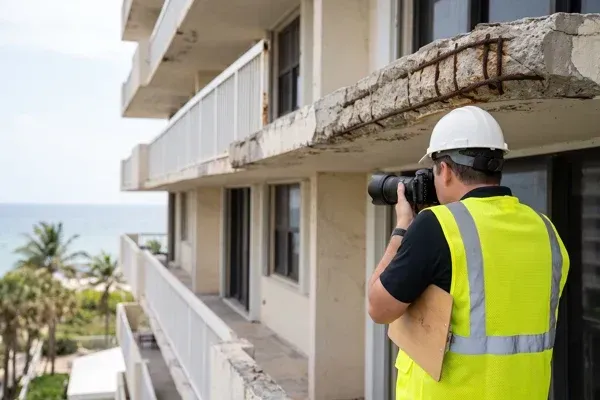
40-Year Recertification in South Florida: 2026 Guide
By Carlos Hoyos, PE, President and Principal Engineer at Hoyos Engineering. Last updated August 2026.
On August 5, 1974, a building leased by the DEA at 1201 NE 2nd Avenue in Miami collapsed, killing seven people and injuring sixteen (Miami-Dade County, 2023). Nine months later commissioners passed Ordinance 75-34 and the 40 year recertification was born. Half a century on, that one local rule has grown into three overlapping programs, and most condo boards we talk to can’t say which one governs their building.
That confusion is expensive. This guide covers what recertification is, how Miami-Dade County, Broward County, and the statewide milestone inspection fit together, when your building is due, what the engineer inspects, and what happens if the report finds problems. Already know you’re due? Our building recertification page explains our process.
Key Takeaways
- Broward’s Building Safety Inspection Program now starts at 25 years for essentially every building type, not just condos (Broward County Board of Rules and Appeals, Policy 05-05, 2023).
- The statewide milestone inspection under Florida Statute 553.899 covers only condominium and cooperative buildings three habitable stories or taller, so a county program may reach your building when the state law doesn’t (Florida Senate, 2026).
- Miami-Dade combines phase one and phase two into a single inspection event and requires an electrical report alongside the structural one (Miami-Dade County, 2023).
- Once the official notice arrives you generally have 90 days to inspect and file in both Miami-Dade and Broward.
What Is the 40 Year Recertification in South Florida?
The 40 year recertification is a mandatory safety inspection of a building’s structure and electrical systems, performed by a Florida licensed engineer or architect and filed with the local building official. Miami-Dade adopted it in 1975 for all buildings except single family homes, duplexes, and minor structures, repeating every 10 years (Miami-Dade County, 2023).
The name is out of date. After Champlain Towers South, Miami-Dade shortened its cycle, Broward rebuilt its program around a 25 year trigger, and Florida created a statewide milestone inspection. Everyone still calls it the 40 year, so we do too. Just know that almost nobody waits until year 40 anymore.
The purpose hasn’t changed since 1975. A trained set of eyes looks at how the building has aged, identifies structural distress and electrical deficiencies, and recommends repairs. Importantly, the goal isn’t to bring an older building up to the current Florida Building Code (Miami-Dade County, 2023). That distinction saves boards a lot of panic.
Miami-Dade, Broward, and the State Milestone Law Are Three Different Things
Here’s the part that trips up boards. Florida Statute 553.899 created a statewide milestone inspection, but it didn’t erase the county programs that predate it. Both counties kept running their own, and both meet or exceed the state floor.
The state law is the narrowest of the three. It applies to buildings three habitable stories or more in height that are subject, in whole or in part, to the condominium or cooperative form of ownership (Florida Senate, 2026). An office building, a strip retail center, or a two story condo isn’t covered by 553.899 at all. It may still be covered by your county.
| Miami-Dade County | Broward County | Unincorporated Palm Beach | |
|---|---|---|---|
| Program | Building recertification (since 1975) | Building Safety Inspection Program | State milestone inspection |
| First inspection | 25 yrs (condo/co-op 3+ stories within 3 miles of coast); 30 yrs all other buildings | 25 yrs, all covered buildings | 25 yrs coastal, 30 yrs inland |
| Repeat cycle | Every 10 years | Every 10 years | Every 10 years |
| Building types | Nearly all, including commercial and industrial | Nearly all, including commercial and industrial | Condo and co-op, 3+ stories only |
| Electrical report | Required | Required | Not required by statute |
| Deadline after notice | 90 days | 90 days | Set by local enforcement |
Sources: (Miami-Dade County, 2026), (Broward BORA Policy 05-05, 2023), (Palm Beach County PZB, 2026).
Two details deserve emphasis. Broward reaches everything at 25 years, exempting only one and two family dwellings, fee simple townhouses, buildings under 3,500 square feet, and government, tribal, and school board properties. And a Broward building safety inspection serves as compliance with both milestone phases under 553.899 (Broward County Board of Rules and Appeals, Policy 05-05, 2023), so you’re not doing the work twice.
When Is Your Building Due for Recertification?
Age runs from the date the certificate of occupancy was issued, not from when construction started. In Miami-Dade, condominium and cooperative buildings three stories or taller within three miles of the coastline recertify at 25 years; every other building recertifies at 30, regardless of location (Miami-Dade County, 2026).
Miami-Dade also created transition years so nothing slipped through when the cycle shortened. Buildings built 1983 to 1997 in the coastal zone, and 1983 to 1992 elsewhere, became due by December 31, 2024, with the cycle reset to 2024, so 2034, 2044, and on (Miami-Dade County, 2023).
Broward is simpler. Every covered building is inspected at 25 years, then every 10 years measured from the year it turned 25, no matter when the previous report was filed. BORA sends each jurisdiction its list by June, and building officials mail certified notices from June through August (Broward County Board of Rules and Appeals, Policy 05-05, 2023). A building official’s failure to send that notice doesn’t excuse you. The obligation is the owner’s.
What Does a Recertification Inspection Actually Cover?
Two reports, structural and electrical, both on the county’s own forms. Structurally we’re looking at the foundation, masonry bearing walls, columns, beams and slabs, floor and roof framing, roof covering, windows and doors, and the building envelope, documenting spalling, cracking, deflection, settlement, and corrosion with photos of worst case conditions.
The electrical scope is just as specific: service equipment, branch circuits, wiring and conduit, emergency lighting, exit signs, fire alarm systems, and infrared thermography on any service rated 400 amps or greater. Who can sign matters too. A Miami-Dade building of three stories or less that isn’t a threshold building can be inspected by any Florida licensed architect or engineer, but four stories and taller needs a Florida licensed structural engineer plus an electrical engineer (Miami-Dade County, 2023).
“The report isn’t the deliverable. The repair plan behind it is. A board that treats recertification as paperwork ends up paying twice.” - Carlos Hoyos, PE
Statewide, phase one is a visual examination. Phase two is triggered only if the inspector identifies substantial structural deterioration, and it can involve destructive or nondestructive testing (Florida Senate, 2026). Miami-Dade collapses both phases into one event. If your building needs concrete work afterward, our concrete restoration team handles repairs and our structural assessments page covers the broader evaluation work.
Not sure whether your building is on this year’s list? Send us the address and the certificate of occupancy year and we’ll tell you which program applies. Start at our contact page or call (754) 354-8475.
What Happens If a Building Fails Its Inspection?
Nothing “fails” in the pass or fail sense. The report either certifies the building as structurally and electrically safe for continued occupancy or lists the repairs required to get there. That second outcome is common in older coastal buildings, and it’s manageable provided the board moves. In Miami-Dade the sequence runs: file the reports immediately even if repairs are needed, get repair plans, pull a permit, do the work, then amend the report to finalize recertification.
Ignoring the notice is where things get serious. Miami-Dade lists electrical disconnection that renders the building uninhabitable, placarding for unsafe conditions, referral to the Unsafe Structures Board, a demolition order, and civil violation notices (Miami-Dade County, 2023). In Broward, an owner who can’t show repairs are scheduled or underway may have the building deemed unsafe and unfit for occupation. There’s also a duty to report: if we find conditions creating an immediate danger of failure or collapse, we notify the building official within 24 hours (Broward County Board of Rules and Appeals, Policy 05-05, 2023). Fire and water damage falls in the same category, which is why we keep fire and water restoration assessment in house.
How Should a Board Prepare for the 90 Day Clock?
Ninety days sounds generous until you’ve tried to schedule an engineer, an electrical inspection, a thermographer, and a board vote inside it. Miami-Dade sends advance courtesy notices two years and one year out precisely so owners can line up funding and permits first. Extensions exist but they’re narrow: up to 60 additional days to file reports, backed by an affidavit that the building can remain occupied, and up to 180 days once a valid repair permit is in hand (Miami-Dade County, 2023). Broward’s building official may grant no more than 60 (Broward County Board of Rules and Appeals, Policy 05-05, 2023).
| Milestone | Miami-Dade | Broward |
|---|---|---|
| Advance notice | 2 years and 1 year out | List issued to cities each June |
| Notice to comply | 90 days | 90 days, certified mail |
| Extension to file | Up to 60 days | Up to 60 days |
| Time for repairs | Up to 180 days under permit | 180 days from report date |
The practical move is simple: pull your certificate of occupancy date, check it against the table, and engage an engineer in the advance notice window rather than the compliance window. Boards that do get competitive repair bids. Boards that wait get whoever’s available.
Frequently Asked Questions
Does the 40 year recertification still exist, or did the milestone inspection replace it?
Both exist. Florida Statute 553.899 created a statewide milestone inspection for condominium and cooperative buildings three habitable stories or taller (Florida Senate, 2026), while Miami-Dade’s 1975 program and Broward’s Building Safety Inspection Program continue to run and cover far more building types than the statute does.
My building is commercial, not a condo. Am I exempt?
Probably not. The state milestone law only covers condominium and cooperative buildings, but Miami-Dade requires recertification of nearly all buildings at 30 years, and Broward covers essentially everything over 3,500 square feet at 25 years (Broward County Board of Rules and Appeals, Policy 05-05, 2023). Offices, retail, and industrial buildings are all in scope.
How is the three mile coastal zone measured?
The statute itself refers to proximity to salt water and lets the local enforcement agency decide (Florida Senate, 2026). Miami-Dade and unincorporated Palm Beach County both adopted a three mile distance from the coastline for the 25 year trigger. Broward sidestepped the question by applying 25 years countywide.
Can any engineer sign my recertification report?
Not always. In Miami-Dade, buildings of three stories or less that aren’t threshold buildings may be inspected by any Florida licensed architect or engineer, but four stories and taller requires a Florida licensed structural engineer with specific DBPR qualifications, plus an electrical engineer for the electrical report (Miami-Dade County, 2023).
What if we renovated the building recently?
You still recertify. Miami-Dade is explicit that extensive alterations under permit don’t reset the clock, because the existing foundation, remaining structure, and underground electrical feeds are still in service. Only complete demolition removes a building from the cycle (Miami-Dade County, 2023).
Talk to a Licensed Engineer Before Your Notice Arrives
If your building is approaching 25 or 30 years, the cheapest version of this process starts early. We’ll confirm which program applies, walk the building, prepare the structural and electrical reports on the county forms, and stay engaged through repairs and the amended report. Founded in 2016, Hoyos Engineering works across Miami-Dade, Broward, and Palm Beach from our Coral Springs office. Request a consultation through our contact page or call (754) 354-8475, review the full scope on our building recertification page, or see everything we handle under services.
Recertification isn’t a formality, and it isn’t a catastrophe either. It’s a scheduled, documented look at how a South Florida building has held up against salt air, humidity, and 25 or 30 years of use, followed by a repair list you can plan and budget around. Boards that treat it as a maintenance cycle rather than an emergency come out ahead.
Your most useful next step is the smallest one: find the certificate of occupancy date, match it to your county’s trigger, and get an engineer on the calendar before the 90 day notice lands. Our building recertification team can take it from there. This article is general information, not engineering advice for a specific property; consult a licensed engineer for your specific project.
Carlos Hoyos, PE, is President and Principal Engineer at Hoyos Engineering, a South Florida structural engineering firm he founded in 2016. A licensed Professional Engineer in the state of Florida and a Florida Atlantic University alum, Carlos brings 20+ years of structural engineering experience, including structural analysis of towers and foundations at American Tower. His team handles structural design, structural assessments, concrete restoration, and commercial buildouts across South Florida.
