
Concrete Spalling in Coastal Florida: Causes and Repair
By Carlos Hoyos, PE, President and Principal Engineer at Hoyos Engineering. Last updated August 2026.
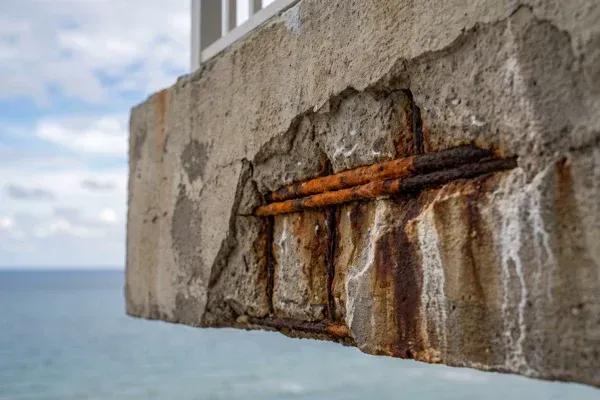
Concrete spalling is the flaking and popping-off of concrete that leaves rusted reinforcing steel exposed on a balcony edge, a column base, or a slab soffit. It looks like a surface problem. It almost never is. Florida DOT classifies any structure over or within 2,500 feet of water carrying more than 2,000 ppm of chloride as a marine structure (Florida DOT, 2018). Most of the built coastline in Miami-Dade, Broward, and Palm Beach sits inside that band.
Below is what’s happening inside the concrete, why salt air accelerates it, how to separate real spalling from cosmetic damage, what an engineer tests, and how the repair options differ.
Key Takeaways
- Spalling is a steel problem, not a concrete problem. Concrete’s alkalinity (pH 12 to 13) keeps rebar passive, and the chloride threshold that breaks that protection is about 0.15 percent soluble chloride by weight of cement (FHWA, 1998).
- Coastal exposure is measurable. FDOT notes structures within line of sight and 2,500 feet of the Atlantic see chloride intrusion around 0.016 lbs/cy/year at 2 inches of depth (Florida DOT, 2018).
- Florida law leaves the judgment to an engineer. Section 553.899 excludes surface imperfections from “substantial structural deterioration” unless the inspecting professional finds they signal something deeper (Florida Senate, 2026).
- Patching alone doesn’t stop it. FHWA found overlays, membranes, and sealers “only serve to slow the corrosion rate but do not stop the ongoing corrosion process.”
What Is Concrete Spalling, and What’s Actually Causing It?
Spalling is the end stage of reinforcement corrosion, not the beginning of a concrete defect. Fresh concrete is strongly alkaline, pH 12 to 13, and that alkalinity forms a tight oxide film on the embedded steel. As FHWA puts it, “As long as this film is not disturbed, it will keep the steel passive and protected from corrosion” (FHWA, 1998).
Chloride ions from salt air, spray, and seawater migrate through the concrete’s pore structure toward the bar. They don’t attack the concrete on the way in. They accumulate. Once the concentration at the steel passes the chloride corrosion threshold, reported by FHWA as 0.15 percent soluble chloride by weight of cement, the passive film breaks down and corrosion begins.
Then it becomes structural. Rust occupies more space than the steel it came from, and the cover contains that expansion until its tensile capacity is exceeded. FHWA describes the sequence directly: when corrosion products “occupy a greater volume than the steel and exert substantial stress on the surrounding concrete, the concrete begins to delaminate and then eventually spall.” The visible spall is the last event in a chain that started years earlier, and the delamination around it is usually far larger than the hole.
Why Do Coastal South Florida Buildings Spall Faster?
Two forces stack: chloride supply and moisture drive. FDOT puts numbers on the first and notes the intrusion rate “decreases rapidly with distance from open waters” and where terrain, foliage, or buildings alter wind patterns. That explains a pattern we see constantly in Fort Lauderdale and Hollywood: east and southeast elevations spall years ahead of the sheltered west face, on identical concrete poured the same week.
The second force is humidity. Miami-Dade’s recertification guidance is blunt: “In this marine climate, highly aggressive conditions exist year-round,” with outdoor relative humidity often 90 to 95 percent against roughly 55 to 60 percent inside an air-conditioned building (Miami-Dade County, 2021). That vapor pressure drives moisture inward through stucco and concrete, and corrosion needs moisture to proceed.
Add the thin, inconsistent cover common in mid-century construction and you get the South Florida signature: heavy spalling at balcony edges, slab noses, and column bases, with interior structure comparatively clean. Our concrete restoration work is built around it.
How Can You Tell Early Spalling From Cosmetic Damage?
Often you can’t from the surface, which is why Florida’s milestone statute puts the call in a licensed engineer’s hands. Section 553.899 excludes surface imperfections such as cracks, sagging, or peeling finishes from “substantial structural deterioration” unless the inspecting engineer determines otherwise (Florida Senate, 2026).
There are field tells, though. Rust staining that bleeds in a straight line traces a bar. A crack running directly over and parallel to a bar is a corrosion crack; one that wanders across the member is more likely shrinkage. And a delaminated area sounds hollow when tapped, even where the surface is intact and painted. Miami-Dade’s recertification form gives you the vocabulary your engineer will use.
| Report item | Miami-Dade’s classification | What it implies |
|---|---|---|
| Crack width | Hairline (barely discernible), Fine (under 1 mm), Medium (1 to 2 mm), Wide (over 2 mm) | Wide cracks over bars suggest advanced section loss |
| Rebar corrosion | “None visible” / “Minor - patching will suffice” | Cover intact or damage localized |
| Rebar corrosion | “Significant - but patching will suffice” | Real corrosion, still bounded |
| Rebar corrosion | “Significant - structural repairs required” | Capacity analysis and engineered repair |
| Spalling | Location and description by beam, column, or other | Extent drives whether further testing follows |
Source: Miami-Dade County 40-Year Building Recertification Guidelines (2021), which warns that “Thin cracks usually indicate only minor corrosion… Extensive spalling may indicate a much more serious condition requiring further investigation.”
What Happens If Spalling Gets Ignored?
It progresses in order, and each step costs more than the last. Cover cracks, delaminates, then falls. The bar, now exposed to unbuffered salt air and wetting, corrodes faster. It loses cross-sectional area, a direct loss of tensile capacity, and bond between steel and concrete degrades.
At that point you’re not discussing a repair. You’re discussing whether the member still carries its assigned load, which is exactly what Miami-Dade’s guidance requires once “corrosion and spalling has been extensive in structurally critical areas.” Boards also underrate the falling hazard: a delaminated soffit over a pool deck is a life-safety issue before it’s a structural one.
“The cheapest spalling repair is the one you do while it’s still a patch. Once we’re analyzing remaining bar area, the conversation has changed and so has the budget.” - Carlos Hoyos, PE
Seeing rust stains or hollow-sounding areas? Send us photos, any original plans, and the location, and we’ll tell you whether it warrants a site visit. Contact our team or call (754) 354-8475. Hoyos Engineering has worked across South Florida from Coral Springs since 2016.
How Does an Engineer Investigate Concrete Spalling?
We start non-destructively and escalate as findings require, mapping the true extent, establishing the cause, and quantifying what sound concrete and steel remain. ACI’s nondestructive testing report covers the method families we draw from, from stress-wave and electrical methods to infrared thermography and radar (ACI PRC-228.2-13, 2013).
| Step | Standard or method | What it tells us |
|---|---|---|
| Delamination survey | ASTM D4580, sounding by chain drag or hammer | Hollow areas beyond the visible spall, found by “noting dull or hollow sounds” |
| Cover and bar location | Cover meter, per ACI PRC-228.2-13 | Whether thin cover explains the pattern; locates bars before coring |
| Corrosion activity | ASTM C876, corrosion potentials of uncoated reinforcing steel | Where steel is actively corroding under sound-looking concrete |
| Chloride profiling | ASTM C1152, acid-soluble chloride | Chloride content by depth, and whether it has reached bar level |
| Petrographic analysis | ASTM C856, petrographic examination of hardened concrete | Concrete quality, paste and aggregate condition, contributing mechanisms |
Chloride profiling is the step boards most often skip, and it’s the one that decides the strategy. Patching a slab already past threshold across the whole member buys a few years, and knowing that before anyone mobilizes changes the scope. Our structural assessments follow this same escalation.
What Are the Repair Options, From Patching to Cathodic Protection?
Repairs run from local and cheap to global and permanent, and the choice is an engineering decision rather than a bid-sheet line item. ACI publishes both a guide to selecting repair materials and methods (ACI PRC-546-14, 2014) and a code for assessment, repair, and rehabilitation of existing concrete structures (ACI CODE-562-21, 2021).
Patch repair removes unsound concrete, cleans or replaces affected bar, and rebuilds the section. It fits localized corrosion where surrounding chloride content is below threshold. The catch: chloride left in the parent concrete around a fresh, chloride-free patch can drive new corrosion at the patch perimeter, an effect engineers call the incipient anode or halo effect. That’s why breakout limits extend past the visible damage.
Coatings, sealers, and overlays slow chloride ingress into concrete that isn’t yet contaminated. They aren’t a cure for concrete that is. FHWA is explicit that they “only serve to slow the corrosion rate but do not stop the ongoing corrosion process,” because chloride ions aren’t consumed by the reaction and stay available to keep it going.
Electrochemical methods address the chemistry itself. Chloride extraction pulls chloride away from the steel; cathodic protection reverses the electrochemistry continuously, and FHWA reports it “has proven to be successful in retarding and controlling chloride-induced corrosion in reinforced concrete bridge components.” Higher cost and ongoing monitoring mean it earns its place where repeated patching has already failed.
Which fits your building depends on the chloride profile, the extent of delamination, and how long you plan to hold the asset. No engineer can guarantee a structural outcome, but a scope built on test data beats one built on a walkthrough every time.
Why Is Spalling the Most Common Serious Recertification Finding?
Partly because the form is built to look for it. Miami-Dade’s structural report carries a dedicated Spalling item asking for location and description, a separate Rebar corrosion item with four graded options, and a line for samples chipped out in spall areas. Few other defect types get their own scale.
Timing compounds it. Miami-Dade requires recertification when a coastal building three stories or taller reaches 25 years, and other buildings at 30 years, then every 10 years after (Miami-Dade County, 2026), while the statewide milestone inspection runs a parallel track. Our 40-year recertification guide untangles the two.
Twenty-five to thirty years is also roughly the window in which chloride that began diffusing on day one reaches bar level on an exposed elevation. The statute and the chemistry arrive together, which is why building recertification and concrete restoration are usually one project, not two.
Frequently Asked Questions
Is concrete spalling always a structural problem?
Not always, but you can’t tell from the surface. Florida Statute 553.899 excludes surface imperfections from “substantial structural deterioration” unless the inspecting engineer finds they signal something deeper (Florida Senate, 2026). Sounding and chloride testing separate a cosmetic repair from a capacity question.
How fast does chloride reach the reinforcing steel here?
It depends on cover depth, concrete permeability, and distance from open water. FDOT cites intrusion around 0.016 lbs/cy/year at 2 inches of depth for structures within line of sight and 2,500 feet of the Atlantic or Gulf, and notes the rate drops rapidly with distance (Florida DOT, 2018).
Will sealing or painting the concrete stop the spalling?
No. Coatings slow chloride ingress into clean concrete but don’t reverse corrosion already underway. FHWA found overlays, membranes, and sealers “only serve to slow the corrosion rate but do not stop the ongoing corrosion process” (FHWA, 1998). Painting over delamination just hides it.
What testing should I expect in a phase two inspection?
Phase two “may involve destructive or nondestructive testing at the inspector’s direction” (Florida Senate, 2026). For spalling that usually means a delamination survey, corrosion potential readings, chloride profiling, and sometimes petrographic analysis. That is the point where a building recertification stops being paperwork and starts driving a repair budget.
Does a spalling repair need a permit in South Florida?
Structural concrete repair generally requires a permitted, sealed design across Miami-Dade, Broward, and Palm Beach. Miami-Dade’s guidance states that “Structural deterioration will always require repair,” with the type driven by the member’s role and the degree of deterioration (Miami-Dade County, 2021).
Get a Real Read on Your Building’s Concrete
Rust stains, hollow-sounding balconies, or a report flagging spalling all point to the same next step: a delamination survey plus enough testing to know what you’re dealing with. We’ll tell you plainly whether it’s a patch or a capacity question. Request a quote or call (754) 354-8475, and see our concrete restoration services or the full service list.
The Bottom Line on Spalling
Spalling in coastal South Florida is chloride-driven corrosion surfacing years after it started inside the member. The visible damage understates the real extent almost every time, and testing decides whether you’re facing a patch or a structural repair.
If your building is approaching its 25 or 30 year mark, get ahead of it. A survey now costs a fraction of an emergency shoring call later, and gives your board something defensible to budget against. Start with concrete restoration, or learn more about our team. This article is general information, not project-specific advice; consult a licensed engineer for your specific project.
Carlos Hoyos, PE is President and Principal Engineer at Hoyos Engineering, a structural engineering firm in Coral Springs serving Miami-Dade, Broward, and Palm Beach counties. He is a licensed Professional Engineer in the state of Florida and studied at Florida Atlantic University. Carlos brings 20+ years of structural engineering experience, including structural analysis of towers and foundations at American Tower, and founded Hoyos Engineering in 2016.
